
What Is Missed Call Text Back & Why It Matters
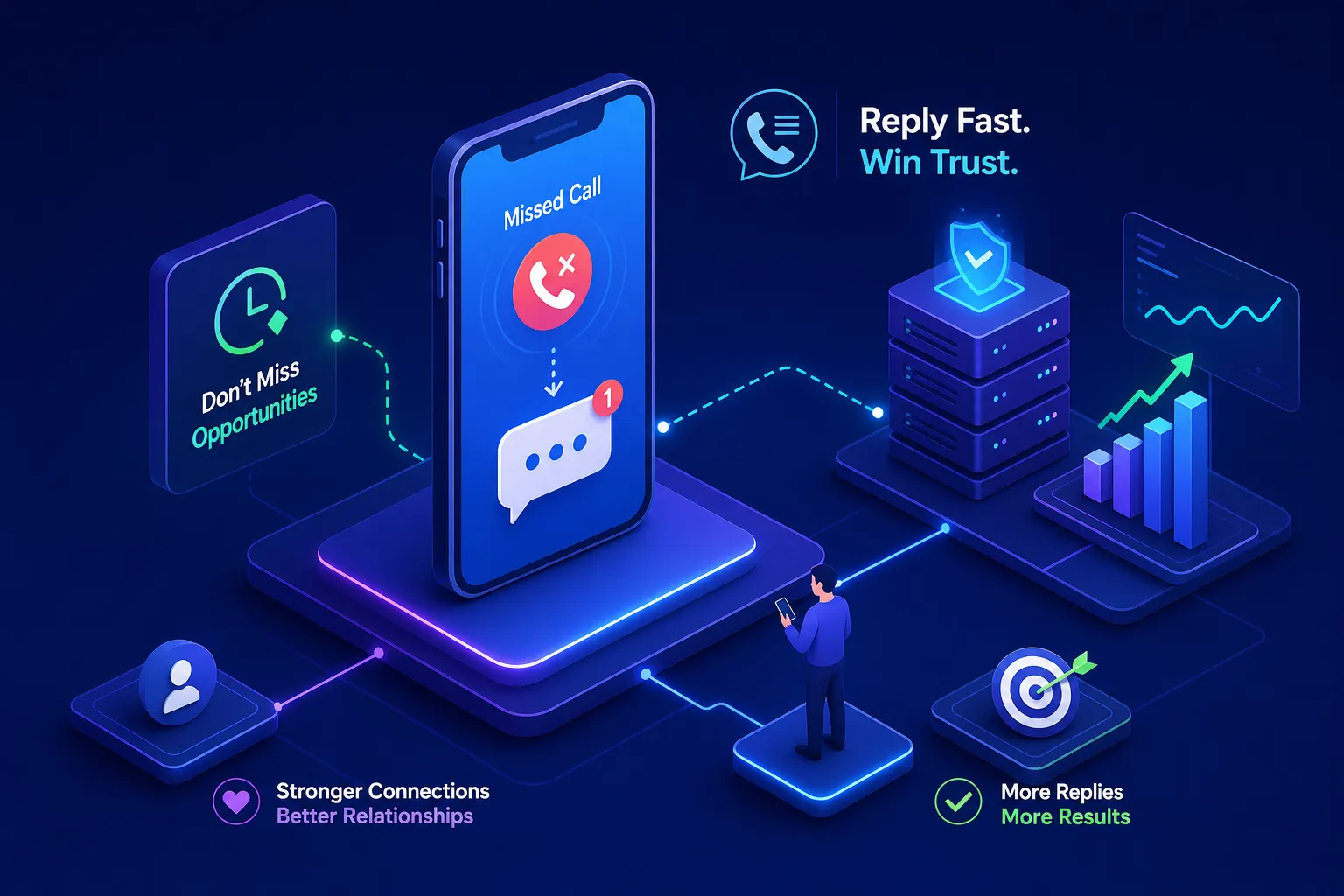
Missed call text back is the fastest way to keep a lead from going cold when you can't pick up the phone. You're under a sink, both hands occupied, and your phone rings. You can't answer. By the time you resurface twenty minutes later, that caller has already booked the other plumber who showed up in the same Google search. This isn't a rare scenario. It's the default for most owner-operators in the trades. Invoca's 2024 call tracking data shows that roughly one in four calls to home service businesses goes completely unanswered, and the majority of those callers never try again.
Automated missed call text back systems close that gap without you having to do anything. The moment a call goes unanswered, the caller receives an SMS within 30 to 60 seconds, keeping the conversation alive while they're still thinking about their problem. More advanced systems like MADLABZ's AI Frontdesk take this further: they handle the reply, qualify the lead, offer a booking link, and notify you only when a job is confirmed. This article breaks down how the whole thing works, what to say in your automated messages, which compliance rules apply, and how to measure whether your system is actually earning its keep.
How a missed call text back works
The sequence starts the moment an inbound call goes unanswered, either after a set number of rings or immediately when the line is busy. The platform detects the missed call event and triggers an outbound SMS to the caller's number. That message typically lands within 30 to 60 seconds. Speed is the whole point here: according to Harvard Business Review research, conversion rates are 8 times higher when a response arrives within 5 minutes, and industry data suggests that waiting longer than 6 minutes causes roughly 80% of potential leads to move on entirely.
What happens next is where systems diverge significantly. A basic missed call autoresponder fires one message and stops. If the caller replies, someone still has to pick up the thread manually, which defeats the purpose when the person most likely to miss calls is also the person least likely to be sitting at a desk. A connected missed call recovery SMS system handles the full sequence: the initial message fires, replies are managed automatically, a booking link is offered, and the owner gets an alert only when something needs human action. One approach patches the problem; the other eliminates it.
Why unanswered calls cost more than service business owners realize
The numbers are worth sitting with. Approximately 27% of calls to home service businesses go unanswered on average, with rates climbing higher during peak hours and after-hours windows. On top of that, data from Velocify indicates that 78% of customers book with the first business that responds to their inquiry. If you're not first, you're statistically not getting that job.
Put that in dollar terms. A plumber who misses five calls a week at an average job value of $300 is walking away from $1,500 in weekly revenue without realizing it. Over a month, that's $6,000. Over a year, that number becomes hard to ignore. The MADLABZ Revenue Loss Calculator lets you run this math against your own job values and call volume, so the gap stops being abstract and becomes a number you can act on.
The psychology of the missed caller makes the problem worse than most owners assume. By the time you return a call 20 or 30 minutes later, most people have already moved on. They're not waiting by the phone. They've called someone else, submitted a form on another website, or simply decided to deal with it later. An automated missed call follow-up text acts in the exact window when the caller is still problem-aware and actively looking for help. That window closes fast.
What a high-converting missed call text back message actually looks like
The anatomy of an effective missed call text back reply is simpler than most people expect. Keep it under 160 characters where possible and open with a brief acknowledgment. Include one clear action the caller can take, and end with opt-out language for compliance. The goal is to feel like a quick human text, not a marketing blast. Overly formal or salesy language tanks response rates because it signals automation immediately, which breaks the trust you're trying to establish.
Here are five templates worth testing, each matched to a specific situation:
- General inquiry: "Sorry we missed your call. How can we help today? Reply here or book online: [link]. Reply STOP to opt out."
- Emergency services: "We just missed your call. Is this urgent? Text back YES for immediate help. Reply STOP to opt out."
- After-hours: "Thanks for calling. We're closed right now but will follow up first thing tomorrow. Reply with details and we'll get right back to you. Reply STOP to opt out."
- Direct booking: "Sorry we couldn't answer. You can book instantly here: [link] or reply with your request. Reply STOP to opt out."
- Choice-based: "Hi, missed your call just now. Would you prefer we call you back or help you over text? Reply 1 for call, 2 for text. Reply STOP to opt out."
The CTAs that consistently outperform are a simple reply invitation, a direct booking link, and a binary yes/no or numbered choice. Low-effort responses drive faster engagement because they ask almost nothing of the caller. A message asking someone to "fill out a form" or "visit our website to get a quote" introduces friction at exactly the wrong moment.
Choosing a missed call text back system that does more than send one text
A standalone missed call text automation tool handles the first message and nothing else. If the caller replies with a question or a request to book, the conversation stalls until someone on your end picks it up manually. For a solo operator or small team where everyone is on-site during the day, that manual handoff is exactly where leads go cold. The whole point of automating the response is that you don't have to monitor it.
A connected system handles the trigger, the initial SMS, reply management, booking, and owner notification as one continuous flow. MADLABZ's AI Frontdesk is built specifically for this sequence. It captures the missed call, fires the automated reply within seconds, manages the conversation thread, offers a booking link when appropriate, and alerts the owner only when a job is confirmed. The owner-operator never has to monitor a back-and-forth or remember to follow up, the system closes the loop automatically.
Vendor pricing for these systems ranges considerably. DIY platforms like GoHighLevel start around $97 per month and offer maximum customization if you're comfortable building workflows. Bundled options like Podium start at $399 per month and include review management alongside messaging tools. MADLABZ takes a different approach: it's purpose-built for the revenue cycle of trade and local service businesses, which means the automation is configured specifically for the way service jobs actually move, from first contact through to booked appointment and paid invoice, rather than being a general-purpose tool you have to configure from scratch. For more details on how that strategy looks in practice, see our AI Business Automation | MADLABZ offerings.
Compliance rules every service business must follow
Here's the plain-English version of what you need to know. Automated SMS replies to missed callers fall under TCPA compliance for SMS, and the consent requirement depends on the content of the message. If your auto-reply is purely informational, meaning it simply acknowledges the missed call and invites a response, prior express consent applies, which is satisfied when a caller provides their number directly to your business. If the message includes any promotional or marketing content, prior express written consent is required, collected through a clear opt-in at a booking form, website sign-up, or point-of-sale interaction. Pre-ticked checkboxes do not satisfy this requirement.
Every automated message must include an opt-out instruction. "Reply STOP to opt out" is the standard. As of April 2025, the FCC also requires businesses to honor opt-out requests through any reasonable channel, not just a STOP keyword reply. That includes email requests, phone calls, or in-person requests, which must be processed within 10 business days. Messaging hours are restricted to 8 a.m. to 9 p.m. in the recipient's local time zone, with some states enforcing a tighter 8 a.m. to 8 p.m. window. Most reputable platforms handle A2P 10DLC brand and campaign registration on your behalf, but confirm this before you go live. Keep records of consent for at least five years.
How to know if your missed call text back system is actually working
Three metrics tell you most of what you need to know. Response rate is the percentage of missed callers who reply to your automated message; a realistic benchmark is around 45%, compared to roughly 6% for email follow-up. Recovery rate is the percentage of those engaged callers who convert into a booked job, which requires connecting your SMS thread to your booking or CRM system to track accurately. Time-to-response should consistently sit under 60 seconds, anything slower starts eroding the speed advantage that makes these systems effective in the first place.
The ROI math is straightforward. Take your average job value, multiply it by the number of missed calls your system recovers per month, and compare that to the monthly cost of the platform. If a system costs $150 per month and recovers two $300 jobs that would otherwise have gone to a competitor, it has paid for itself four times over in the first month alone. Running this against your own numbers through the MADLABZ Revenue Loss Calculator takes about two minutes and gives you a clear dollar figure to evaluate. If the gap looks significant, an Automation Audit can identify exactly where in your current setup the revenue is leaking before any system changes are made.
Closing the gap between a missed call and a booked job
Automated missed call text back replies don't solve every challenge in your lead pipeline, but they close the single most common and most expensive gap in a service business's revenue cycle. The moment a call goes unanswered is the moment a lead starts cooling. An automated SMS sent within 60 seconds, written to feel human and connected to a booking flow, keeps that lead warm until it converts.
For service businesses ready to stop patching this problem manually, a connected missed call text back system handles the entire sequence automatically. The follow-up becomes the first step in a chain that ends with a confirmed appointment and a paid invoice. If you're not sure how much unanswered calls are currently costing you, run the numbers first. The result usually makes the next step obvious.
Is Your Service Business Leaking Revenue?
No matter how good your CRM is, missed calls, slow response times, and uncaptured reviews will cost you jobs. Let's find out exactly how much you can recover.